Two Hours Early, One Lifelong Friend: My Love Letter to the Person Behind the Mixing Desk
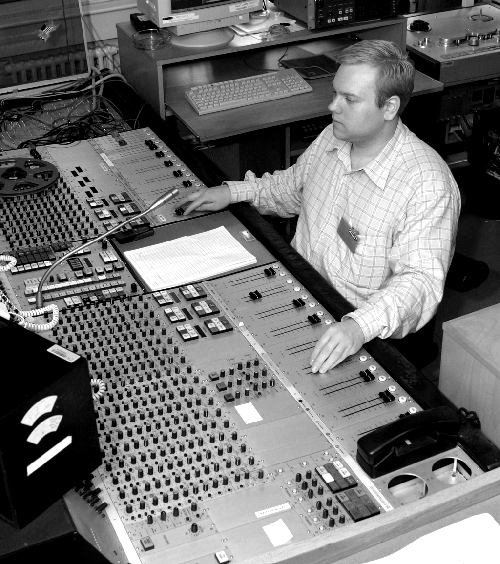
Photo: Unknown, CC BY-SA 3.0, via Wikimedia Commons
There's a photograph somewhere of me, aged nineteen, hunched over a four-channel mixing desk in a Working Men's Club in Rotherham, having absolutely no idea what I was doing. The singer's vocals were feeding back at a frequency that could summon bats. The bassist had unplugged himself mid-song for reasons lost to history. And the man who eventually rescued us all — a chap called Dave with a lanyard, a headtorch and the calm of a man who had seen empires fall — taught me the most important lesson of my career.
Be nice to the sound engineer.
Actually, that undersells it. Befriend the sound engineer. Bring them a brew. Learn their name before you learn the name of the venue. Because here's the truth that nobody puts on the booking form: the difference between a gig that lifts the roof and a gig that limps to the bar is rarely the performer. It's the person at the desk.
The Two-Hour Rule
I arrive at every booking two hours before I'm needed. Not for warm-ups — you can warm up in a car park. I arrive early because the first forty minutes of any engagement should be spent in the company of whoever is running the room.
This is not altruism, whatever I may imply on stage. It's self-interest dressed as charm. The engineer who likes you will walk your vocal around the room to check the coverage. The engineer who dislikes you will set your levels by eye, from the bar, during the first chorus.
I've played rooms where I made that early effort and rooms where I breezed in with twenty minutes to spare, and I can tell you the difference is audible. One wedding in the Cotswolds, the engineer — Sam, brilliant, allergic to small talk, won over entirely by a bacon roll — spent their break rebuilding my monitor mix so the mother of the groom's toast didn't clash with my backing track. Nobody in that room knew Sam existed. Everybody in that room had a lovely evening. Correlation? Absolutely.
Confessions of a Desk-Adjacent Romantic
Over the years I've collected engineers the way other people collect fridge magnets. There's the woman in Glasgow who mixes folk nights and can diagnose a duff DI box by smell alone (I believe this; I've never tested it). There's the theatre technician in Brighton who once held the whole show together with gaffer tape, a smartphone torch and what I can only describe as theatrical spite. There's the gentleman at a corporate do in Birmingham who, upon learning I needed a mic for the raffle, produced one from a drawer marked, genuinely, 'SPARES OF LAST RESORT'.
What unites them all is that they are the most under-thanked people in live entertainment. The booker remembers the magician. The audience remembers the band. The engineer remembers everyone, and is remembered by no one.
And they see everything, by the way. They see the bride's dad weeping during the first dance. They see the magician's 'invisible thread' catching the light because someone left the stage wash up at 100%. They see which performers turned up on time and which ones treated the soundcheck as optional. Engineers have long memories and shorter guest lists than you'd think.
A Plea to the People Doing the Booking
If you're organising an event — a wedding, a works do, a village fete with ambitious lighting — here's my advice, free of charge: budget for the tech crew like they're part of the entertainment, because they are.
I've watched bookers haggle hard on the engineer's fee and then act bewildered when the PA sounds like it's being broadcast through a tin of Quality Street. I've seen venues cut the changeover time to nothing and then blame the crew when the evening runs late. The tech crew is not overhead. The tech crew is the reason your Aunt Maureen's speech was heard at the back, and the reason the DJ's final song didn't dissolve into hum.
So: give them a socket that works. Give them a table that isn't next to the toilets. Give them five minutes of your time to explain the running order. And if you can manage it, give them a plate of food. A fed engineer is a loyal engineer, and a loyal engineer will make your average performer sound like a star and your star performer sound like a miracle.
The Toast
So this one's for Dave in Rotherham, wherever you are. For Sam in the Cotswolds. For every roadie who's carried a flight case up three flights of stairs in a building with no lift and no apology. For the venue staff who find the extension lead, who tape the cable, who stay until the last amp is packed away while everyone else is already in the taxi.
You are the invisible half of every great night out. I see you. And more to the point, I arrive two hours early to make sure you see me — holding a cup of tea, and asking how you'd like the vocal in the monitors.
It's a relationship, after all. And like all good relationships, it runs on tea, flattery and not touching their faders without asking.