Twenty-Nine Minutes to Showtime: What Actually Happens Before You Sit Down
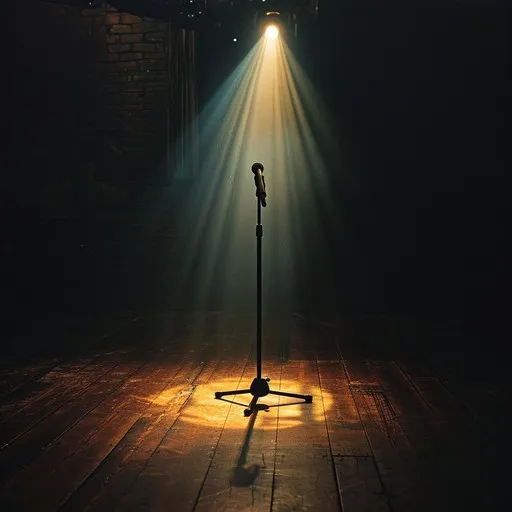
Photo: empty stage soundcheck microphone dim venue lights, via images.stockcake.com
There's a moment, roughly thirty minutes before a show, when the audience believes nothing is happening. The room is empty. The chairs are in neat rows. Somewhere, a kettle is being boiled by a volunteer in a cardigan. To the casual observer, the performer has not yet arrived.
The performer has, in fact, been there since 4:45pm, having a quiet disagreement with a double socket behind the bar.
The Socket Always Wins
Every venue in Britain has exactly one working plug socket, and it is always in the least convenient possible location. I've crawled under stages in Leeds, balanced on milk crates in a Suffolk village hall, and once ran a whole cabaret off an extension lead borrowed from a man called Trev who was only there to fix the boiler. The socket is the first boss battle of the evening, and you never know which difficulty setting you're getting. Sometimes it hums encouragingly. Sometimes it spits, trips the entire lighting rig, and plunges the function room into the kind of darkness usually reserved for séances.
You learn to carry adapters. You learn to carry more adapters than you think any human could reasonably need. You learn that the phrase "yeah, there's power behind the stage" means something different to every venue manager in the country.
The Vanishing Venue Manager
Which brings me to the venue manager: a figure of folklore. They are warm, welcoming and endlessly helpful right up until approximately forty minutes before doors, at which point they evaporate. Where do they go? Nobody knows. I imagine a room somewhere, filled with venue managers, all drinking tea and comparing notes on which performer they left standing in an empty room holding a mic cable and a look of quiet betrayal.
In their absence, you become the venue manager. You move the piano three inches left because the sightline is wrong. You discover the "disabled access" is a ramp so steep it qualifies as gym equipment. You find the light switch for the stage lights is behind the bar, next to the crisps, labelled — I promise this is true — "MISC."
The Soundcheck Is a Conversation
Once the electrics have been placated and the manager has dematerialised, comes the soundcheck. People assume soundcheck is a technical exercise. It is not. It is a negotiation between you, the room, and whatever the room has decided to be that day.
Rooms have moods. A function room above a pub in Birmingham on a rainy Tuesday sounds completely different to the same room on a Saturday. The acoustics shift with the humidity, the number of chairs, and whether the window above the fire exit has been left open since the previous tenant's leaving do in 2019. You hum a few bars. The room answers. Sometimes the answer is "warm and lovely." Sometimes the answer is "like singing into a biscuit tin on a platform at Clapham Junction."
You adjust. You walk the room. You clap once, sharply, and listen for the slap-back echo that will make your punchlines arrive twice, like a heckler with a delay pedal.
The Rituals Nobody Sees
By now, a rhythm has developed — every performer has their own pre-show liturgy. Mine goes something like this:
- Greet the staff. Learn one name. This is not sentimentality; the person who knows where the spare fuses are is worth more than any rider.
- Find the loo before you need the loo. A lesson learned at cost, in a rugby club, mid-trick.
- Check the sightlines. Sit in the worst seat. If the magic doesn't work from there, it doesn't work.
- Waste five minutes quietly panicking. Non-negotiable. The panic is load-bearing.
- Reset. Cards fanned, cables taped, water within reach. Breathe.
There's something oddly sacred about it, in the end. The audience sees the polished forty minutes and assumes it arrived fully formed, like a ready meal. It didn't. It was assembled in that strange, empty half-hour — by torchlight, over a humming socket, while somewhere a venue manager was having a cuppa in a parallel dimension.
So next time you're at a gig and the act walks on seemingly without a care, spare a thought for the twenty-nine minutes you didn't see. The real show started long before the lights came up.
It just didn't have a very good plug socket.